Solitaire Tripeaks - Farm Trip
- 4.8
- Rating
- 5.00M
- Installs
- Free
- Price

 Analysis by App-foxy
I went into Solitaire Tripeaks - Farm Trip expecting a familiar card game with a light farming theme, and that is exactly where its appeal lies. The main activity is a Tripeaks-style solitaire experience, while the surrounding farm idea gives the individual hands a little more purpose than simply clearing cards and starting again. It is easy to understand, free to start, and calm enough for short breaks, but it still has enough decision-making to keep the game from feeling like a completely automatic tap-through.
My overall impression is that this is best viewed as a relaxed card game rather than a full farming simulation. The farm setting adds atmosphere and progression, but the cards remain the reason to stay. If you enjoy solitaire and want a softer, more decorative presentation, this is a sensible choice. If you are looking for deep farm management, competitive card play, or a completely interruption-free experience, you should approach it with different expectations.
What the game feels like after the first few hands
The central rhythm is straightforward: reveal the layout, remove cards in sequence, and look for the next playable move. That simplicity makes the game approachable for people who do not normally play card games on mobile. I never felt that I needed to study a long rulebook before beginning. The basic goal becomes clear through play, which is important for a game designed around quick, casual sessions.
You May Also Like

 Blood Strike: 2.5 Anniversary
Blood Strike’s Loadouts Turn Every Drop Into a Tactical Gamble
A close look at Blood Strike’s custom loadouts: how fast access to signature weapons reshapes its battle royale rhythm, rewards preparation, and narrows the gap between fights.

 Pandora - Music & Podcasts
Pandora’s Music Is Easy to Start, but Harder to Recover
Pandora’s strength is its low-effort path from a seed to a station. Its weak spot is how much confidence it asks you to place in connection, setup, and quiet recovery.

 8 Ball Pool
 Is Built on Rivalries, Rematches, and Routine
A close look at the rivalries, rematches, shared routines, and unanswered safety questions that turn a quick pool match into a persistent mobile community.

 Samsung Music
’s Quiet Strength Is Playing What You Already Own
Its reach comes less from spectacle than from dependable access to a personal library. That simplicity is both the app’s strongest retention engine and its ceiling.

 AccuWeather: Weather Radar
AccuWeather Review: A Quick, Clear Forecast for Everyday Decisions
For everyday plans, the best forecast is the one you can understand quickly. AccuWeather makes rain timing, radar, and local conditions easy to act on, with a few trade-offs.

 Hill Climb Racing
Why Hill Climb Racing Still Turns Crashes Into One More Run
A tiny car, a bumpy hill and one more upgrade: Hill Climb Racing keeps resurfacing because its simple chaos makes every near-miss feel personal.
More From Our News Desk



The Tripeaks format also creates more tension than ordinary Klondike solitaire in a small amount of time. A move can open several cards, but using the wrong card too early may leave a useful sequence unavailable later. I found myself paying attention to the visible layout instead of tapping without thinking. That small layer of planning is what gives the game its staying power.
The farm theme changes the mood rather than replacing the card game. Planting, harvesting, and building provide a reason to continue through hands, while the card layouts supply the moment-to-moment activity. I like that division because it makes progress feel lighter. You can focus on a single hand when you have only a few minutes, then return later without needing to remember a complicated management plan.
That said, the farm layer will not satisfy someone who wants detailed resource planning or a large construction system. The attraction is the combination of gentle visual progress and solitaire, not the depth normally associated with a dedicated farming title. This distinction matters when deciding whether the game belongs on your phone.
Where new players are most likely to get stuck
The first friction point is usually not the rules but the pace of decision-making. Because the game looks relaxing, it is tempting to remove any available card immediately. A better habit is to inspect the exposed cards first and ask which move opens the most useful information. In Tripeaks, a move that appears convenient can be less valuable than one that reveals another card and preserves a longer run.
I also recommend checking the stock before committing to a sequence. When several cards are available, I try to use the move that keeps the greatest number of future options alive. This is a practical difference between playing deliberately and simply clearing whatever is easiest. It will not transform every hand into a win, but it reduces the feeling that a loss arrived without warning.
Another common sticking point is the relationship between the farm progress and the card result. The farming presentation can make it seem as though every hand should produce a large visible change. In practice, the card table is still the part that demands attention. I found the experience more enjoyable when I treated the farm as a gentle reward structure instead of expecting it to behave like a separate strategy game.
Players who are used to classic solitaire may also need a short adjustment period. Tripeaks layouts are less about building traditional suits and more about finding consecutive ranks from the available card. That makes the game faster and more accessible, but it also means an apparently harmless move can close off a route. Taking a second to scan the board is the most useful early tip I can offer.
Setup checks before blaming the game
The game is free, and it is suitable for Everyone, which makes it easy to try on a shared family device or a personal phone. It runs on Android 7.0 and later, so an older compatible phone may be able to install it. Before starting, I would still check that the device has enough free storage, a stable connection during installation, and an up-to-date app store. These are ordinary checks, but they prevent many problems that can look like a game fault.
If installation pauses, I would first close other downloads and restart the store rather than repeatedly tapping the install button. A temporary connection change can also help: switching between Wi-Fi and mobile data may reveal whether the issue is the network or the device. If the game installs but immediately closes, a full device restart and a check for pending system updates are sensible first steps.
It is also worth looking at the age of the phone before judging performance. The minimum operating-system requirement is not a promise that every supported device will feel equally smooth. Background apps, limited memory, heat, and low storage can all affect a casual game. I would close demanding apps before playing and avoid evaluating the experience while the phone is already struggling with several tasks.
Because the game includes optional in-app purchases ranging from $0.99 to $99.99 per item, I would review purchase controls before handing the phone to a child. The game itself is free, but free installation and optional spending are separate decisions. On a family device, setting a purchase confirmation requirement is a practical safeguard, especially when the card play feels simple enough for younger users to explore independently.
A reliable routine when a session behaves strangely
When a hand does not load correctly or the screen stops responding, I would avoid immediately clearing storage. First, I would leave the game, reopen it, and confirm that the phone still has a working connection. If that does not help, I would restart the device. These steps are deliberately conservative because clearing app data can remove local progress or settings, depending on how the game handles saved information.
If the problem appears after switching between apps, I would close the game completely and launch it again without opening several other applications first. This is especially useful on older phones where the operating system may reclaim memory in the background. I would also make sure the current installation is the latest available version, which is listed as 2.31.7.20260629. Updating is not a guaranteed fix for every problem, but it is a sensible check before more disruptive troubleshooting.
For a stuck card or an unresponsive button, patience can matter. I would wait briefly after a tap, particularly if the device is warm or the connection is unstable, instead of pressing repeatedly. Multiple taps can make it difficult to tell whether the game is delayed or has received several commands. Reopening the session gives a cleaner test.
If the issue continues, I would note exactly when it happens: during launch, while loading a hand, after returning from another app, or during a purchase attempt. That detail is more useful than simply saying that the game is broken. It helps separate a display problem, a connection problem, and a store transaction problem. I would only consider reinstalling after checking whether progress is safely associated with the game’s available saving method, because reinstalling can be a poor first response when progress matters.
When the app is probably not the cause
Not every interruption comes from the game itself. A weak signal can make an online-dependent step appear frozen, while a nearly full phone can cause installation and updates to fail. Battery-saving modes may restrict background activity, and aggressive device-cleaning tools can close games at inconvenient moments. If other apps are also slow, crash, or fail to download, I would investigate the phone or network before focusing on this particular title.
Payment problems deserve the same separation. If a purchase does not complete, the cause may be the app store account, a payment method, parental controls, or a connection interruption rather than the card game. I would check the store’s transaction status before trying again, since repeating a purchase too quickly can create unnecessary confusion. The safest approach is to confirm whether the transaction was actually processed and then use the appropriate store support route if needed.
Notifications, sound, and display behavior can also be affected by device settings. Silent mode, media volume, screen overlays, accessibility tools, and battery restrictions may change how the game feels without indicating a defect in the game. I prefer to test with ordinary settings first, then re-enable personal preferences one at a time. That method is slower than guessing, but it makes the source of the problem easier to identify.
There is another kind of “problem” that is really a mismatch of expectations. The game may feel repetitive if you want a constantly expanding farm or a competitive solitaire ladder. That is not something a restart or update can solve. The core loop remains card clearing with a relaxing farm presentation, so anyone seeking a more complex simulation should choose a dedicated farming game instead.
Small choices that make the card loop better
My most useful playing habit is to delay the obvious move when it preserves flexibility. I look across the exposed cards, identify which ranks can be connected, and prefer a sequence that reveals new cards without consuming a rare option too early. This is particularly helpful when the layout offers several possible directions. The aim is not to predict the entire hand, only to avoid closing doors unnecessarily.
I also treat the stock as a limited planning resource rather than a button to press whenever the board slows down. Before drawing again, I check whether an exposed card can be removed by a different route. That pause often reveals a move I missed. It makes the game feel more strategic without turning a relaxing session into serious mental work.
Short sessions are another strength. I would use it while waiting for an appointment, during a quiet commute when it is safe to do so, or as a wind-down activity before bed. A realistic routine is to play a few hands, stop at a natural break, and return later rather than chasing a win after frustration sets in. The farm framing supports that stop-and-start pattern better than a game that demands long uninterrupted sessions.
For someone playing on a smaller screen, I would keep the phone in a comfortable orientation and avoid tapping rapidly near the edges of the card layout. In a Tripeaks game, a mistaken tap can be more annoying than in a purely decorative app because it may alter the sequence. Slowing down slightly is a better trade-off than trying to play at maximum speed.
How it compares with familiar solitaire and farming alternatives
Compared with classic Klondike solitaire, this game is quicker to understand and more focused on consecutive-card decisions. It does not offer the same traditional tableau-building feel, so players who enjoy carefully arranging suits may prefer a standard solitaire collection. I would choose this one when I want a more compact hand and a lighter sense of progress around it.
Compared with a plain Tripeaks app, the farm presentation gives the session a stronger reason to continue. The trade-off is that the experience is less stripped down. If you want the fastest possible route from one card layout to the next, decorative progression may feel like an extra layer. If you like seeing a relaxing theme develop around repeated hands, that layer is exactly the point.
Against a full farming game, the difference is much larger. Here, the cards are the main event, and the farm is a companion structure. A dedicated farming title is a better fit for players who want production chains, detailed building choices, or a broader simulation. I would recommend this game instead to someone who wants the emotional comfort of a farm setting without committing to a complicated management routine.
The audience response is encouraging: the game holds a 4.8 average from around 99 thousand ratings, has about 10 thousand written reviews, and has passed 5 million installs. Those figures suggest that its accessible blend of solitaire and farming has found a substantial audience. They do not remove the need to consider the optional purchases or the limited depth of the farm side, but they do support my impression that the basic formula works for many casual players.
Who should install it, and who should skip it
I would recommend it to solitaire fans who want a gentle change from traditional layouts, people who enjoy farm themes but do not want a demanding simulation, and anyone looking for a game that can be played in brief, low-pressure sessions. It is also a reasonable choice for a family device because the content rating is Everyone, provided that purchase controls are handled responsibly.
I would be more cautious about recommending it to players who dislike repeated card layouts, expect every decision to be skill-based, or want a game with no optional spending at all. Randomness and limited moves can make a hand feel unwinnable from a player’s perspective, even when the presentation remains cheerful. Someone who needs a completely predictable puzzle experience may prefer a logic game with fixed solutions.
I would also skip it if the main goal is deep farming. The title’s strongest identity is still card solitaire. The farm theme makes the repetition more pleasant and gives progress a visual context, but it does not turn the game into a substitute for a full agricultural strategy experience.
My practical verdict after using the full concept
Solitaire Tripeaks - Farm Trip succeeds because it understands the value of a simple loop with a comforting setting. The card play is approachable, yet careful sequencing gives experienced players something to think about. The farm framing adds motivation without requiring the player to manage a complicated system, and that makes the game particularly suitable for short breaks.
Its limitations are equally clear. The experience can become repetitive, the farming side is lighter than a dedicated simulation, and optional purchases mean that families should check device controls before letting children play freely. Setup and performance problems may also come from storage, memory, connection, or store issues rather than the game itself, so basic troubleshooting is worth trying before reinstalling.
Fruit Puzzle Games has built a focused card game rather than an all-purpose mobile world. For me, that focus is a positive when I want a calm way to occupy a few minutes. I would install it for the Tripeaks hands, keep the farm theme as a pleasant bonus, and judge each session by whether I enjoyed the decisions rather than by how quickly I advanced.
My recommendation is simple: choose it if you want relaxed solitaire with a colorful farming wrapper and enough planning to keep each hand interesting. Choose another option if you need deep farm management, traditional Klondike rules, or a completely purchase-free experience. As a free card game for casual Android play, it earns a place on my list, provided you approach it for what it is instead of expecting a full farming simulator.
FAQs for Solitaire Tripeaks - Farm Trip
01What is Solitaire Tripeaks - Farm Trip?
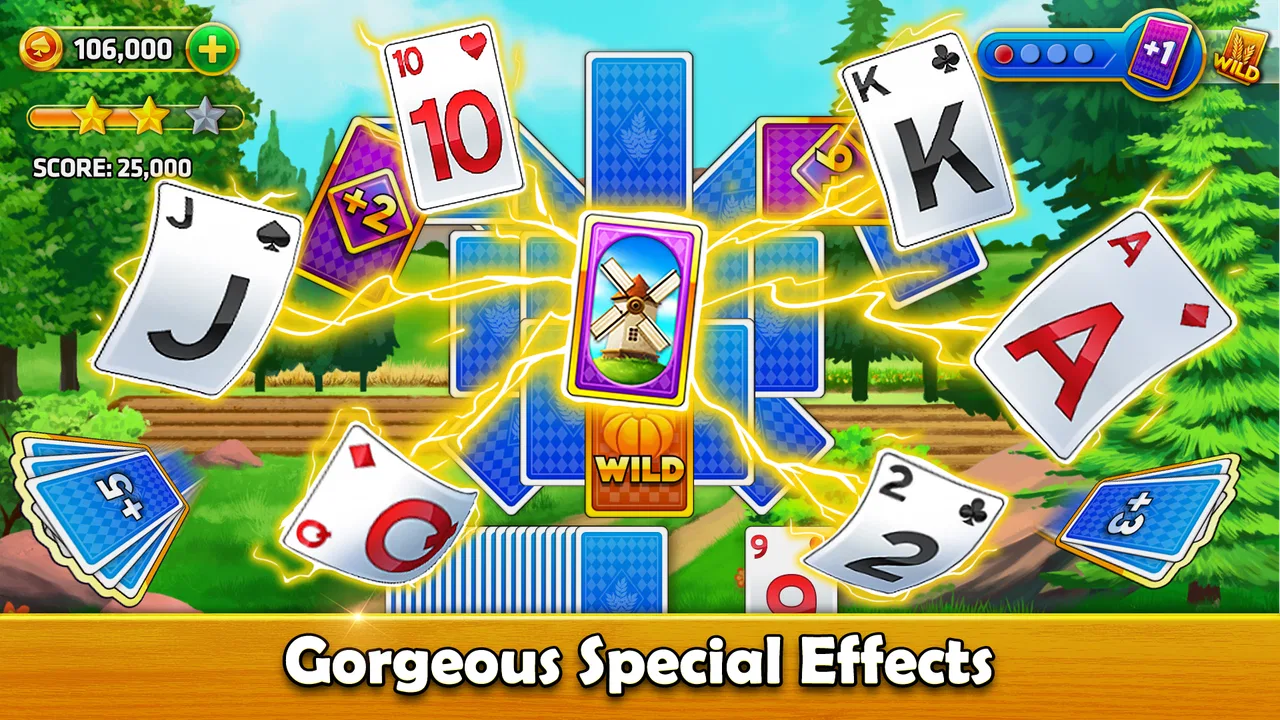
Solitaire Tripeaks - Farm Trip is a casual card game that combines classic TriPeaks solitaire with a colorful farm-themed adventure. You clear cards from the board by selecting cards one value higher or lower than the card in your discard pile. Along the way, the game adds level objectives, farm visuals, rewards, and progression elements that make each short round feel more like part of a larger journey.
02How do you play Solitaire Tripeaks - Farm Trip?
Each level presents a layout of face-up and face-down cards. You remove an available card when its value is one rank above or below the current discard card, while aces can generally connect with kings depending on the game rules. Building a longer sequence helps you earn better results, but you must plan carefully because moves are limited by the cards available and the stock pile.
03Is Solitaire Tripeaks - Farm Trip free to download and play?
The game is generally available as a free download, allowing players to begin playing without purchasing it upfront. However, free-to-play features may include optional advertisements, in-game currency, boosters, extra moves, or other purchases. The exact offers can vary by device, region, and version, so it is worth checking the store listing and reviewing purchase settings before allowing children to play.
04Does Solitaire Tripeaks - Farm Trip require an internet connection?
Many solitaire levels can often be played without a constant connection, which makes the game convenient for short sessions while traveling or when mobile data is unavailable. Nevertheless, an internet connection may be needed for advertisements, cloud synchronization, updates, events, rewards, or in-app purchases. Offline availability can also change after updates, so test the game before relying on it during a trip.
05Is Solitaire Tripeaks - Farm Trip suitable for children and casual players?
The simple card rules, bright farm presentation, and short levels make Solitaire Tripeaks - Farm Trip approachable for casual players and older children who already understand basic number sequences. Parents should still review advertising, optional purchases, data practices, and age recommendations shown on the relevant app store. Difficulty can increase over time, particularly when levels introduce tighter objectives or more limited resources.
Pros
- Relaxing solitaire gameplay with an enjoyable farm-themed setting.
- Simple controls make it easy for new players to start quickly.
- Short levels are convenient for casual play sessions.
- Colorful visuals give the game a cheerful
- family-friendly feel.
- Progression and rewards add motivation beyond individual card rounds.
Cons
- Some levels may depend heavily on luck rather than strategy.
- Energy or waiting systems can interrupt longer play sessions.
- Frequent ads may appear unless you choose an ad-free option.
- Later challenges can encourage spending on boosters or extra moves.
- The gameplay may feel repetitive for players seeking more variety.

Solitaire Tripeaks - Farm Trip
Gallery